
Localized Search vs Geo-Targeted SEO: Which Reaches Customers?
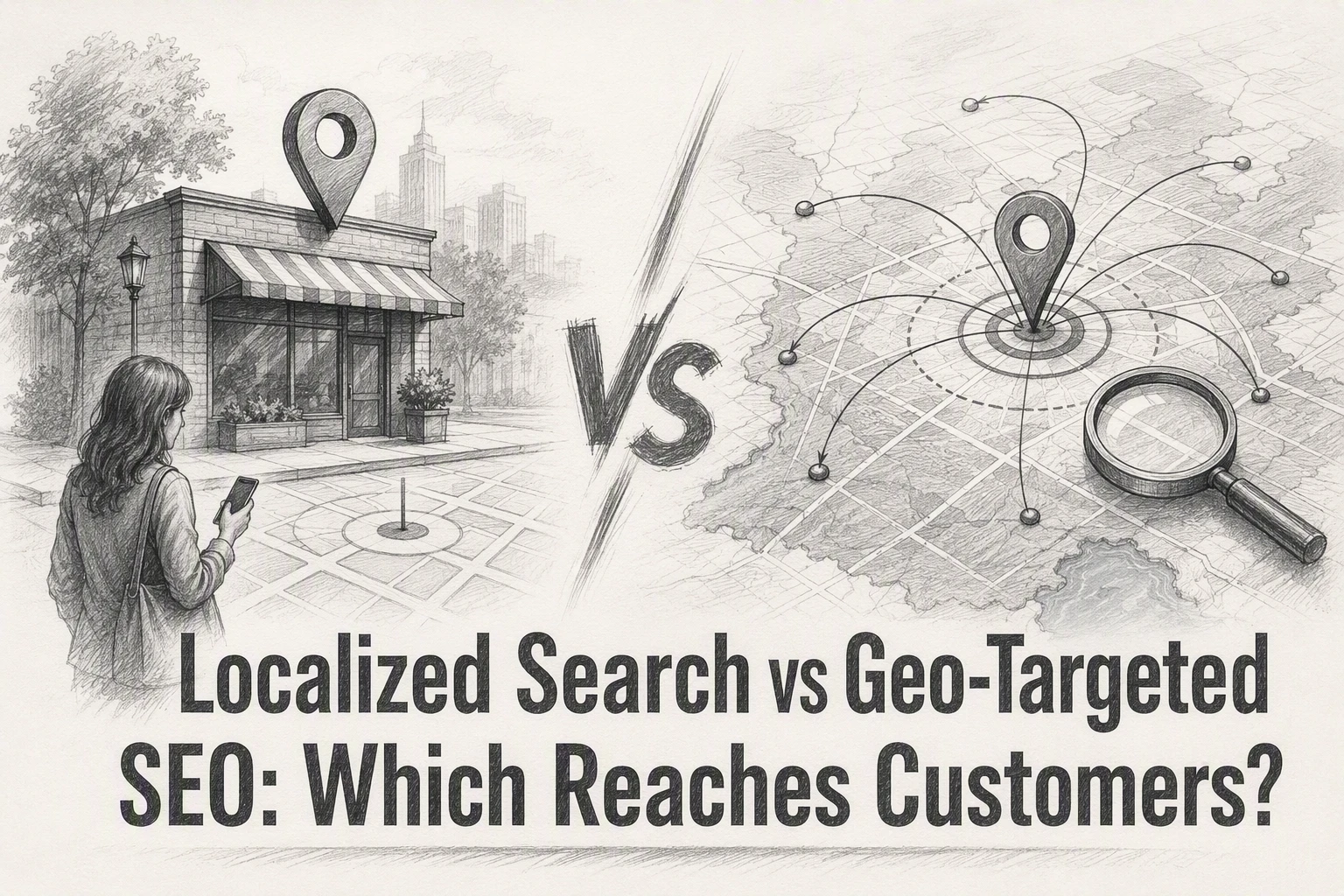
Quick Summary: Localized search should be your first priority because it captures nearby, high-intent customers through Google Maps and local results, while geo-targeted SEO helps expand reach into additional cities or regions over time. Most service businesses need both, but start by nailing down your Google Business Profile, service pages, and reviews before building pages for new markets. Never clone a page for each city, create thin location pages, or claim an office where you don't operate, or you risk Google's doorway penalty. For multi-area expansion, build distinct, useful pages with local proof like case studies and FAQs.
A homeowner needing a roofer wants a trusted company that serves their address now. Localized search meets that need first. Geo-targeted SEO helps you grow into chosen areas. This guide separates both, so you can prioritize Maps, city pages, ads, and site fixes that drive qualified leads. Localized search is the immediate priority for most service firms.
Localized Search vs Geo-Targeted SEO: At a Glance
| Localized search | Geo-targeted SEO | |
|---|---|---|
| Primary purpose | Match customers with relevant local businesses | Expand organic visibility across chosen locations |
| Geographic scope | Often neighborhood, city, or service-area based | Multiple cities, regions, states, or countries |
| Main visibility surfaces | Google Maps, local pack, localized organic results | Location pages, service pages, organic search results |
| Best fit | Businesses serving customers in a defined area | Multi-area, remote, regional, or national providers |
| Core signals | Relevance, distance, prominence, reviews, local details | Useful local content, crawlable structure, links, entities |
| Measurement focus | Calls, directions, visits, inquiries, booked work | Rankings, organic clicks, leads, market expansion |
How Localized search and Geo-targeted SEO Compare
Localized search
Localized search matches nearby customers with relevant businesses in Maps, the local pack, and local results. It suits firms with a defined service area, where relevance, distance, reviews, and business details shape visibility, as Google explains. Key strengths
- Captures high-intent local demand
- Supports calls, directions, and bookings
Geo-targeted SEO
Geo-targeted SEO is a planned organic strategy for chosen cities, regions, or wider markets. It fits businesses expanding beyond one area through useful location content, crawlable site structure, and strong local signals. Key strengths
- Builds reach across selected markets
- Supports organic leads and market growth
What Localized Search and Geo-Targeted SEO Actually Mean
Localized Search Starts With Customer Intent
Localized search happens when a customer seeks a nearby answer, such as "plumber near me." Google uses relevance, distance, and prominence to match that person with useful local results, according to Google's local ranking guidance.

- The customer controls the location signal.
- Results can change across neighborhoods.
Geo-Targeted SEO Starts With Market Selection
Geo-targeted SEO is your plan to reach chosen cities or service areas. You create useful location pages, local proof, and clear service details for markets you can truly serve.
Key insight: Geo-targeting supports local visibility. It cannot make your business physically closer to every searcher.
Which Approach Reaches Customers More Effectively?
Choose Localized Search First When Proximity Drives the Sale
Choose localized search if customers need help nearby, fast. Google says local results weigh relevance, distance, and prominence, so accurate business details and real reviews matter for map visibility. Google's local ranking guidance confirms distance is a core factor.

Prioritize your Business Profile, service pages, reviews, and clear service boundaries before expanding.
Choose Geo-Targeted SEO When Reach Must Expand
Choose geo-targeted SEO when you can profitably serve several cities or regions. Build useful pages for each real market, with local proof and a direct path to book. Do not clone one page and swap city names.
Also Read: Growth Strategy for Service Brands: 7 Digital Plays
How to Combine Both Without Creating Thin Location Pages
Build Local Relevance Before Scaling Geography
Start with the places you truly serve. Strengthen your core service pages, local proof, and conversion paths before adding nearby cities.
- Use real service areas and customer needs.
- Support each page with local reviews, projects, or FAQs.
Google flags pages built mainly to funnel similar searches to one destination as doorway abuse. Read Google's guidance.
Make Every Location Page Earn Its Place
Give each page facts a customer cannot find elsewhere.
| Include | Why it matters |
|---|---|
| Local case study | Shows real work nearby |
| Area-specific service details | Sets clear expectations |
| Relevant CTA | Helps visitors take action |
Which Should You Choose: Localized Search or Geo-Targeted SEO?
Choose localized search to capture nearby, high-intent customers. Choose geo-targeted SEO when you serve several real markets and can build useful pages for each.
Google lets service businesses define up to 20 service areas in their Business Profile.
Use both, but never claim an office where you do not operate.
Reach more local customers with the right mix of search, ads, and landing pages. Talk with Harrigan Creative to build a revenue-focused service-area strategy.
Frequently Asked Questions
Q1: Which approach better reaches customers in specific service areas?
Use localized search to capture nearby intent. Use geo-targeted SEO to build pages for priority towns. Most service businesses need both.
Q2: Do I need a page for every city?
No. Create useful pages for areas you truly serve, with distinct proof and offers.
Q3: Can paid ads support local SEO?
Yes. Ads test demand fast while SEO builds lasting visibility.
Conclusion
Localized search follows customer intent. Geo-targeted SEO builds reach in chosen areas. Match both to real service coverage, since Google weighs relevance, distance, and prominence.